

Field Report
When Time Breaks Identity
Jan 14, 2026 · 8 min read
Intermittent authentication failures often look random because the root cause is temporal, not logical. Identity systems assume disciplined time and stable trust boundaries. When those assumptions slip, failures appear everywhere and nowhere at once.
Outcome: Time sources standardized, drift monitoring enabled, and authentication failures traced to credential issues instead of clock skew.
At a glance
- Goal
- Unified authentication across on-prem AD, Azure AD, and virtualization hosts.
- Constraint
- Kerberos tolerance is strict (5 minutes). Drift creates invisible boundaries.
- Reality
- Random login failures were traced to asymmetric clock drift across trust zones.
Engineering standards used
- Time is a dependency, not a setting. It must be monitored like disk space.
- Single authoritative source for the entire trust chain (Stratum 1).
- Drift is an incident. Any skew > 60s triggers a P2 alert.
Identity is a time-sensitive system
Authentication is not just about credentials. It is about time. Kerberos tickets, SAML assertions, OAuth tokens, TLS handshakes, and even session cookies are all anchored to timestamps. A few minutes of drift is enough to invalidate a token, reject a certificate, or break a replay-protection window.
The systems doing the checking assume a shared time model. When that model fractures, identity breaks in ways that feel arbitrary. One login succeeds, the next fails. A user can authenticate on one host but not another. The dashboard stays green, yet users are locked out.
Why it feels random
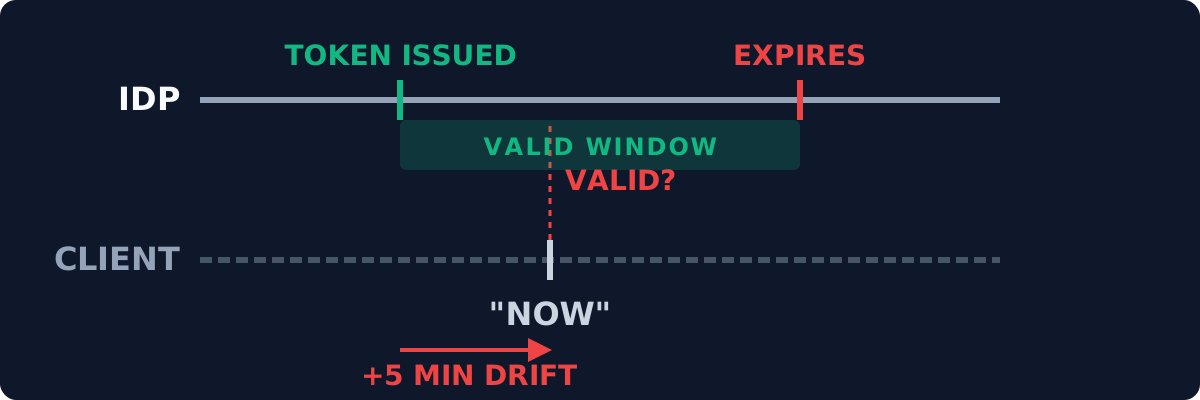
Time drift creates asymmetric failure. Each component accepts a different tolerance. A token might be valid for five minutes on the identity provider, but only for two minutes on a downstream API. A domain controller may be three minutes behind, a hypervisor host two minutes ahead, and a container ten seconds fast. Each individual system looks fine in isolation, but the combined trust chain is inconsistent.
The result is a pattern that looks like a bad password, a buggy client, or intermittent network instability. It isn't. It's clock discipline.
Common failure patterns
- Kerberos tickets rejected. Authentication succeeds in one zone and fails in another because time skew exceeds the allowed window.
- OIDC or SAML assertions fail validation. "Not before" or "expires" claims are outside the server's local time.
- API tokens intermittently invalid. Token issuers and consumers disagree on the current time, creating seemingly random 401s.
- TLS handshake failures. Certificates appear "not yet valid" or "expired" because the system clock is wrong.
Trust boundaries amplify drift
Identity is not a single system. It is a chain of trust across networks, hosts, and services. When identity crosses a boundary (on-prem to cloud, corp to SaaS, data center to branch), time quality often drops. That boundary is where assumptions get violated.
A few examples:
- Virtualization stacks. VM guests rely on the host for time. If the host is drifting or paused, the guest clock jumps.
- Stretched networks. WAN links introduce variability and can cause stratum misconfiguration, especially when sites fall back to their own local time source.
- Container platforms. Time is inherited. If the node drifts, every pod inherits the error.
Infrastructure hygiene that identity depends on
The solution is not to tune the identity system. The solution is to enforce time discipline where identity is consumed.
- Authoritative NTP sources. Define a small set of trusted time sources and force all systems to use them. Avoid mixing public pools and local sources without explicit policy.
- Clock monitoring. Alert on time drift, not just NTP reachability. A reachable server can still be wrong.
- Host consistency. Keep hypervisor hosts synchronized and confirm VM guest settings for time sync are consistent and supported.
- Runbook clarity. Document time sources per zone and define the recovery step when drift is detected.
Why NTP can look healthy and still be wrong
Many monitoring setups only check that the NTP service is reachable. That isn't the same as being accurate. A host can sync to the wrong source, follow a drifting local clock, or accept a time source that is itself misconfigured. All of those conditions appear "healthy" in a basic status check.
Virtualization and power management make it worse. Suspend/resume cycles, host pauses, or snapshot rollbacks can move time abruptly. The system may rejoin the network and report NTP as "active," but the clock can still be minutes off until it re-stabilizes.
Root cause checklist for identity drift
- Confirm NTP source hierarchy and stratum across all identity-critical systems.
- Verify time sync settings for hypervisor hosts and VM guests.
- Check for drift on domain controllers and identity providers first.
- Compare token "not before" and "expires" claims with local system time.
- Look for time jumps after maintenance windows, backups, or host migrations.
How to validate the fix
You are done when the failure becomes boring. That means:
- Clock offset is within a strict tolerance across all identity-critical systems.
- Authentication failures align with real credential or policy issues, not time.
- Tokens issued and consumed across boundaries validate consistently.
A simple test is to validate time offset at each hop in the identity path: identity provider, domain controllers, application servers, APIs, and clients. If any link is off, the chain will fail eventually.
Why this matters operationally
Random auth failures erode trust faster than a visible outage. Users lose confidence, operations lose time, and the root cause hides behind layers of logs. Time drift is rarely the first suspect, which is why it persists. Treat time as a first-class dependency. Identity systems are only as reliable as the clocks they assume.
Engineering principle
Identity runs on time.
If the clocks disagree, the trust chain will too.
Related notes
All notesField Report
The Idempotency Audit: When Scripts Run Twice
Jan 17, 2026 · 6 min read
Why 'check-then-act' logic is fragile, and how a script that ran twice broke production.
Checklist
Azure Foundations: The Governance Baseline
Jan 17, 2026 · 5 min read
The boring but essential checklist that prevents Azure environments from rotting into ClickOps chaos.
Checklist
What Operators Actually Check on Monday Morning
Jan 14, 2026 · 7 min read
The minimal checks that prevent silent regression when the consultants are gone.
Next step
If this problem feels familiar, start with the Health Check.
It measures drift and recovery evidence, then returns a scored report with a focused remediation plan.