

Checklist
What Operators Actually Check on Monday Morning
Jan 14, 2026 · 7 min read
After a stabilization project, the real test is Monday morning. Operators don't run 40-page runbooks under pressure. They run a handful of checks that are fast, repeatable, and actionable. Those checks prevent silent regression.
Monday morning, the operator way
There's a particular moment on Monday morning that only operators really recognize. It isn't an alert. It isn't a ticket. It's that quiet window before the week asserts itself, when the systems have been running unattended for two days and you finally get to ask a simple, dangerous question:
Did anything drift while nobody was looking?
Monday is the cheapest moment to notice drift before it collides with change windows, deployments.
What Monday checks actually are
Despite what tooling vendors imply, Monday-morning checks are not a checklist you can download. There's no universal list. The check is the first human checkpoint after a quiet stretch. It exists to surface exceptions, not to explain them.
By midweek, you're reacting. On Monday, you still have leverage.
Why long runbooks fail under pressure
Runbooks are not the problem. Unbounded runbooks are. Over time, they grow by accumulation: every incident leaves a scar, and every exception becomes a paragraph. Eventually, the runbook stops being an operational tool and becomes a historical document.
Under pressure, operators default to what they can do quickly and repeatably. They best handoff extracts a small set of checks that keep the environment stable when nobody is watching.
Shallow, by design
A good Monday-morning check is intentionally shallow. If it requires deep analysis, historical forensics, or a meeting, it doesn't belong here. This is not the time for architecture reviews or capacity planning. It's a fast pass designed to surface exceptions, not explain them.
Think of it as the operational equivalent of a pilot's walk-around. You're not disassembling the aircraft. You're looking for the things that shouldn't be true before you take off.
What experienced operators learn to look for
Over time, operators develop an instinct for certain kinds of risk:
- The things that don't alert.
- The things that don't fail loudly.
- The things that get more painful the longer they're ignored.
These are learned the hard way—through postmortems, near-misses, and the occasional "how did this get this bad?" moment. The details differ from environment to environment, but the categories rhyme.
That's why good operators don't copy each other's checklists. They copy each other's thinking.
The point isn't heroics
When Monday-morning checks work, nothing exciting happens. No fires. No war rooms. No clever fixes. The system just keeps behaving—quietly, predictably, boringly.
Operational maturity isn't about catching spectacular failures. It's about noticing slow, quiet problems early enough that they never get the chance to become interesting.
That's what Monday morning is really for.
The Monday list (minimum viable)
The actual checks are unglamorous. They're about coverage, drift, and the few failure modes that get more expensive every day they sit unnoticed.
- Backup coverage exceptions. Not “jobs are green,” but “are any production workloads unprotected?” Coverage gaps are the most common silent failure.
- Snapshot age. Snapshots older than a small threshold (days, not months) are performance debt and recovery risk disguised as convenience.
- Capacity drift. A datastore or volume that is filling faster than usual is a leading indicator. You want the slope, not the percentage.
- Host health exceptions. Hardware warnings, storage path flaps, degraded links. Exceptions only. No one reads a sea of green.
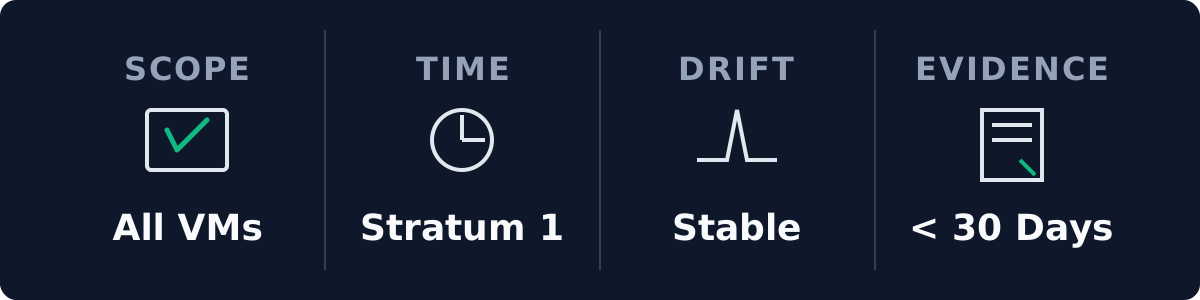
- Time discipline (identity-adjacent). If authentication has ever felt “random,” include an NTP drift check for identity-critical systems. Small skew becomes noisy fast.
- Restore test freshness. “Do we have recent proof for tier‑1 systems?” A restore test older than the cadence is stale evidence.
Silent regression is the enemy
Most environments don't fail explosively. They degrade quietly, in the places that don't always alert. Monday checks work because they catch drift while it's still cheap—turning “we think we're covered” into “we can point to proof.”
What not to monitor (because it never changes)
Operators ignore dashboards that are always green. Those checks create noise, not confidence.
- Generic utilization averages. CPU and RAM oscillate constantly and rarely explain incidents by themselves.
- Single-number “health scores.” Rolled-up numbers hide the failure mode you actually need to act on.
- “All services up” widgets. If they are never wrong, they have no signal value.
- Anything without a threshold and an action. If the check can't tell you what to do next, it doesn't belong in the Monday list.
Make the checks easy to run
The best checklist is the one that survives a busy week. That means it has to be frictionless.
- One screen. A single dashboard or a single email digest.
- Same format. Same order, same thresholds, every time.
- Exceptions only. Highlight what changed, not what is normal.
- Ten minutes. If it takes longer, it becomes optional.
If something is red
A Monday check isn't useful if it stops at detection. Every check should map to a short response path: acknowledge, capture evidence, and resolve or escalate.
- Unprotected workloads: fix scope, run an active full, schedule the next restore test.
- Old snapshots: coordinate a window, consolidate with validation, document the source so it doesn't repeat.
- Capacity slope change: identify the growth driver, confirm retention settings, act before it becomes an outage.
Operator-first principle
Make it repeatable, not impressive.
If Monday morning is calm, the system is actually stable.
Related notes
All notesField Report
The Idempotency Audit: When Scripts Run Twice
Jan 17, 2026 · 6 min read
Why 'check-then-act' logic is fragile, and how a script that ran twice broke production.
Checklist
Azure Foundations: The Governance Baseline
Jan 17, 2026 · 5 min read
The boring but essential checklist that prevents Azure environments from rotting into ClickOps chaos.
Field Report
When Time Breaks Identity
Jan 14, 2026 · 8 min read
Why authentication failures feel random when clocks drift and trust boundaries are misunderstood.
Next step
If this problem feels familiar, start with the Health Check.
It measures drift and recovery evidence, then returns a scored report with a focused remediation plan.