

Decision Note
Decision Note: Deferring a Major Version Upgrade
Jan 14, 2026 · 6 min read
We deferred a major platform upgrade after weighing recovery certainty, operational stability, and reversibility against the value of new features.
Outcome: Upgrade deferred, compensating controls implemented, restore-test cadence increased, and decision log updated.
Context
We evaluated a major version upgrade inside a core infrastructure layer: virtualization, storage firmware, or backup software. The release promised meaningful features and better alignment with the vendor roadmap, but it also introduced change across multiple surfaces at once: disk formats, management tooling, drivers, and recovery behavior. The existing platform is stable and predictable. That stability is not passive luck; it is a control we depend on to maintain RPO and RTO commitments with confidence.
Decision
We chose to defer the upgrade. This is not a permanent refusal. It is a timing decision. We will revisit after additional validation, compatibility work, and a lower-risk change window. The goal is to protect recoverability and operational continuity, not to avoid progress.
What we optimized for
We prioritized reversibility, measured recovery, and the ability to explain outcomes in a single page of evidence. If a change cannot be validated or rolled back cleanly, it is not ready for production. That keeps the system boring in the best sense: consistent, observable, and recoverable.
- Predictable maintenance windows with explicit validation steps.
- Restore proof over feature promise.
- Minimal blast radius per change.
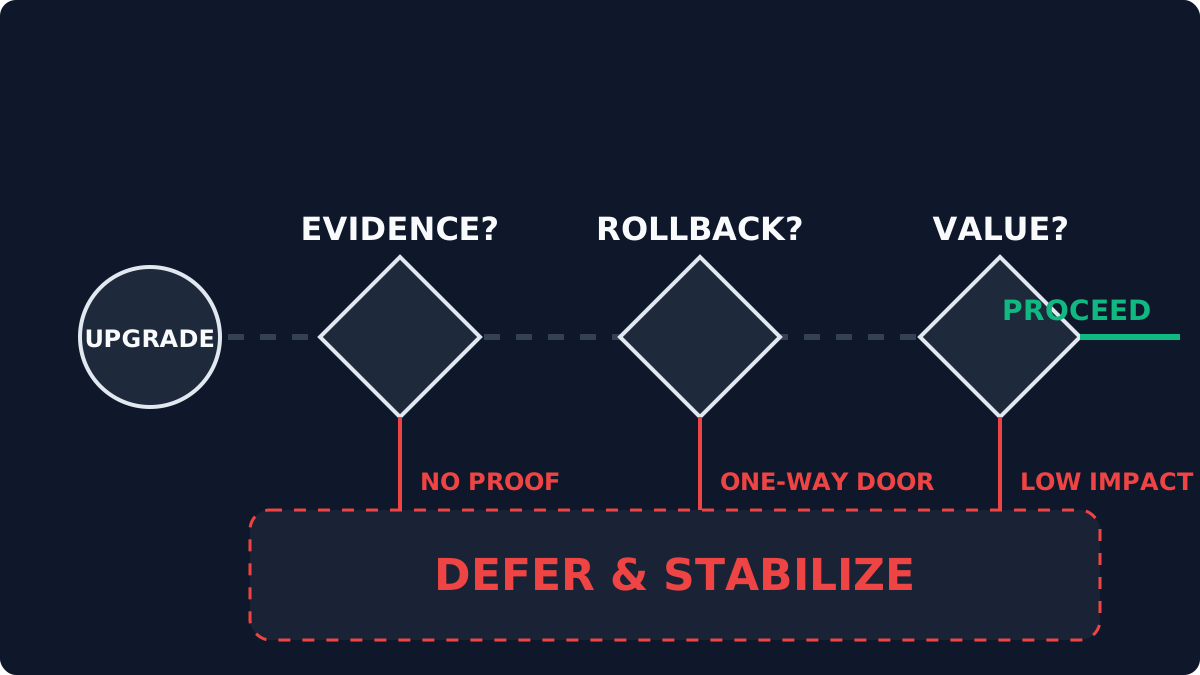
Decision Snapshot
- Decision: defer the major version upgrade.
- Primary objective: maintain reversibility and recovery certainty.
- Tradeoff: postpone non-essential features in favor of stability.
Risks considered
- Recovery and rollback risk. Major versions often change on-disk formats or metadata handling. Rollbacks can be destructive, not reversible.
- Operational continuity risk. Upgrades require maintenance modes, evacuations, or service restarts. This introduces uncertainty in production behavior.
- Compatibility risk. Hypervisor, firmware, drivers, and storage paths move together. Small mismatches can create latency spikes or transient data unavailability.
- Backup integrity risk. Backup software upgrades can alter formats, encryption, or retention logic. A defect here does not show up until the restore.
- Operational response risk. New versions change telemetry and error patterns, slowing triage when time is critical.
Evidence reviewed
- Internal stability metrics. Incident frequency and MTTR were stable or improving, with no operational pressure forcing immediate change.
- Restore test results. Recent tests met RPO/RTO targets on current versions, providing hard evidence of recoverability.
- Vendor release notes and known issues. The release included active caveats, and multiple issues were still tracked for the first patch cycle.
- Compatibility matrices. Our environment includes mixed hardware and driver generations that require staged remediation before an upgrade.
- Peer outcomes. External reports showed uneven stability until point releases arrived.
- Business timing. The upgrade window overlapped with higher-risk operational periods where downtime would be unusually costly.
Compensating controls implemented
Deferral is only defensible when you offset risk. We implemented controls that increase evidence and reduce drift while keeping change reversible.
- Restore validation cadence. Increased restore test frequency for tier-1 systems, with evidence retained for each test.
- Targeted patching. Applied security and stability patches within the existing major line to reduce known exposure.
- Configuration hardening. Standardized settings across clusters and removed known sources of drift.
- Rollback readiness. Documented rollback procedures for current patch levels and verified credential access.
- Monitoring refinements. Elevated visibility for storage latency, backup job success, and restore anomalies.
Why this is the responsible choice
The decision is grounded in restraint, not fear. We are not anti-upgrade. We are anti-irreversibility without proof. Major upgrades should reduce risk or unlock required capability. In this case, the benefits were incremental while the recovery and change risks were real. Preserving a stable baseline keeps the system predictable and recoverable, which is the foundation for any future change.
Revisit criteria
We will re-evaluate after the following conditions are met:
- Vendor point release reduces known-issue surface area.
- Compatibility gaps are remediated across firmware and drivers.
- Lab upgrade and rollback rehearsal is completed successfully.
- Two consecutive restore tests meet RPO/RTO under the planned versions.
- A lower-risk maintenance window is available.
Deferral is a choice to keep the environment safe while we prove the upgrade path. We will move when we can do it reversibly, with evidence, and without turning stability into a gamble.
Operating principle
Stability before novelty.
A major upgrade is a one-way door unless you can prove the way back.
Related notes
All notesField Report
The Idempotency Audit: When Scripts Run Twice
Jan 17, 2026 · 6 min read
Why 'check-then-act' logic is fragile, and how a script that ran twice broke production.
Checklist
Azure Foundations: The Governance Baseline
Jan 17, 2026 · 5 min read
The boring but essential checklist that prevents Azure environments from rotting into ClickOps chaos.
Checklist
What Operators Actually Check on Monday Morning
Jan 14, 2026 · 7 min read
The minimal checks that prevent silent regression when the consultants are gone.
Next step
If this problem feels familiar, start with the Health Check.
It measures drift and recovery evidence, then returns a scored report with a focused remediation plan.