Google Jules: Cloud-Native Agentic Engineering
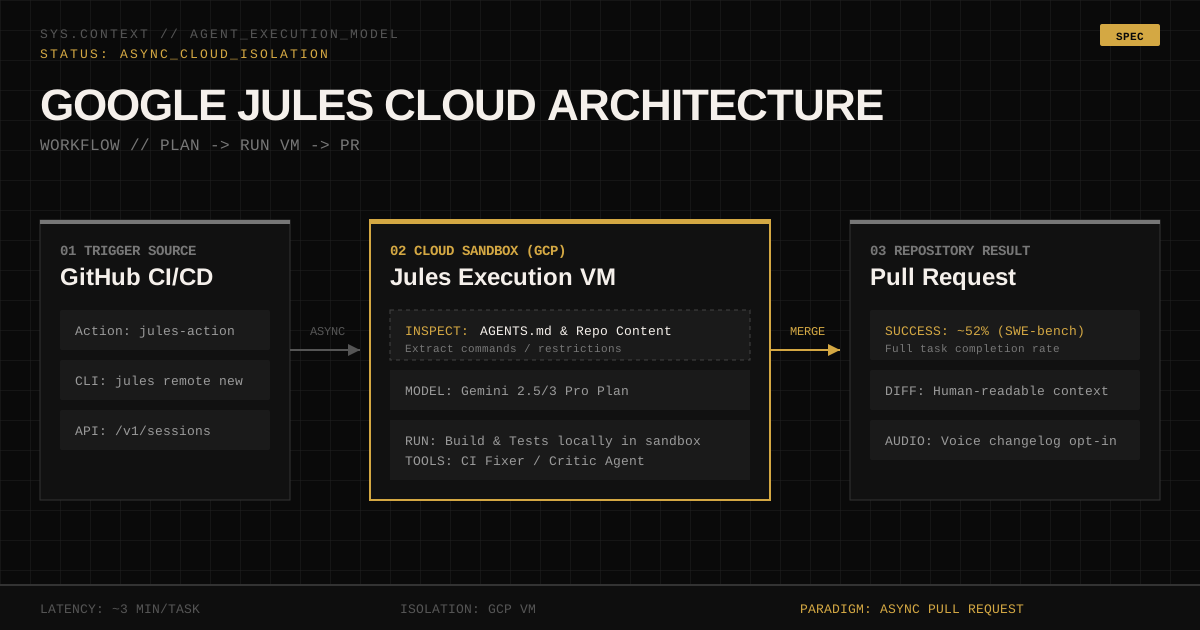
Agentic engineering is migrating from the local IDE to the cloud. Google Jules represents a fundamental shift in how teams automate codebase maintenance. Instead of generating code synchronously at the cursor, Jules operates asynchronously directly against the repository, orchestrating multi-step tasks inside sandboxed cloud environments.
It replaces the copilot model with an independent worker model.
The Plan-First Cloud Architecture
Jules executes in secure, ephemeral Google Cloud virtual machines. It is not a local application that competes for your laptop's memory. You assign it a task—via a CLI, API, or web interface—and it analyzes the repository, proposes a detailed execution plan, and then performs the work in its isolated cloud sandbox.
This architecture has immediate practical implications:
- Asynchronous Execution: You trigger a task (like upgrading a framework dependency or adding unit tests) and move on. Jules works in the background.
- Diffs and PRs: Jules culminates its execution by generating a GitHub pull request. It surfaces the diffs alongside plain-text explanations (and even audio changelogs) for human review.
- State Isolation: The agent test-drives code in isolated environments, eliminating the "works on my machine" problem across agent runs.
Direct CI Integration
The jules-action allows teams to weave autonomous coding directly into their CI/CD pipelines. This enables triggering agentic tasks based on repository events.
For example, a failed static analysis check or a Dependabot alert can programmatically spawn a Jules session via the API. The agent can then analyze the failure, draft a fix, and open a PR without human intervention. Jules inherently functions better when treated as an infrastructure component rather than a flashy chat interface.
Guiding Jules with AGENTS.md
Autonomous agents fail when they misunderstand repository invariants. Jules standardizes repository guidance using AGENTS.md.
By placing an AGENTS.md file at the root of a repository, development teams establish the ground rules for the agent. This file codifies:
- Standard build and test commands (e.g.,
pnpm build:local). - Testing environments.
- Coding style requirements and restricted patterns.
Jules automatically reads this file during its initial planning phase. It reduces hallucination and prevents the agent from attempting incorrect build commands inside its VM.
The Current State of the Engine
Public reports point to Jules achieving ~52% task success rates on the SWE-bench Verified benchmark. This is realistic. Roughly half of complex automated tasks will succeed fully without human intervention.
The value proposition is not perfection; it is throughput. Delegating dependency upgrades, generating missing tests, and executing tedious, multi-file refactors to a cloud-hosted agent frees up senior engineering capacity.
Jules is a hosted service, meaning execution and infrastructure are managed by Google Cloud. For teams with stringent data residency or total on-premise execution requirements, the lack of a documented self-hosted path is a constraint. However, for organizations already operating in the cloud, Jules enforces a disciplined, PR-driven approach to agentic coding that outpaces simple text autocompletion.
Next step
Most engagements start with the Health Check. Fixed fee, clear picture, under two weeks.